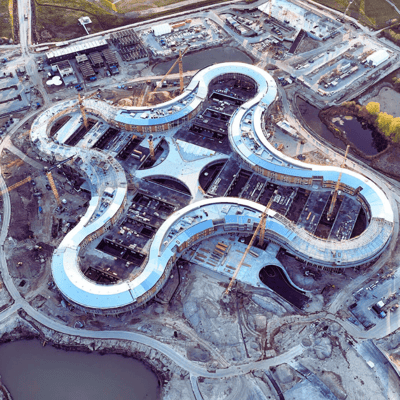
Over the past 16 months, the construction team responsible for the iconic new Nyt Hospital Nordsjælland near Copenhagen achieved remarkable results with the Imerso construction AI technology, enhancing work productivity while preventing costs and delays worth €5.2 million during the construction of the superstructure.
Inspired by this success, the team led by Project Manager Anders Kaas has since been eager to explore the potential of the technology in other areas.
The opportunity emerged to address a topic that has traditionally posed significant challenges and expenses in numerous construction projects: ensuring regulatory compliance of fire barriers and fire wall construction.
It's extremely frustrating that we have to spend so much effort - and so much time - in the final phase of the project to correct something that should never have been a problem, namely the incorrectly executed fire closures.
Vejdirektoratet’s director of construction
Non-compliance with fire-safing standards can lead to exorbitant repair costs and prevent critical societal projects like hospitals and airports from opening doors to operations entirely. In light of recent fire incidents in the UK, fire-protection compliance has surfaced as a pressing concern, coinciding with stricter regulations within the UK construction industry.
In Denmark, perhaps the most infamous recent case is that of the landmark Niels Bohr university construction — The project suffered precisely this fate in late 2021 when final inspections revealed that over 10,000 fire closures had not been done properly.
The client, Vejdirektoratet’s director of construction Erik Stoklund Larsen commented:
It's extremely frustrating that we have to spend so much effort - and so much time - in the final phase of the project to correct something that should never have been a problem, namely the incorrectly executed fire closures."
This incident prompted the Roads Directorate to conduct further investigations into fire wall construction on various construction projects to prevent similar incidents from occurring elsewhere.
Critical infrastructure buildings like the Nyt Hospital Nordsjælland must adhere to hundreds of fire-safety codes.
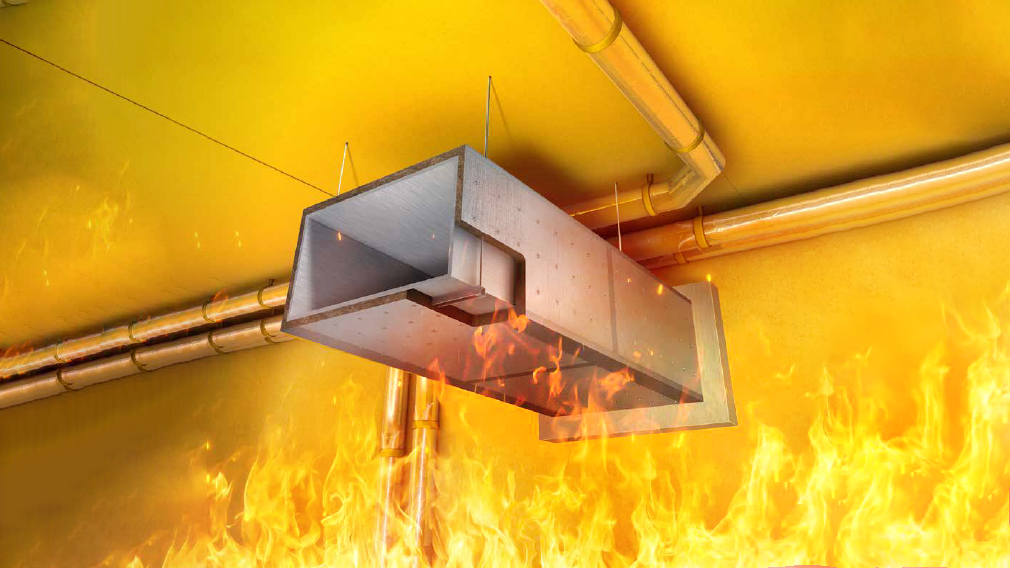
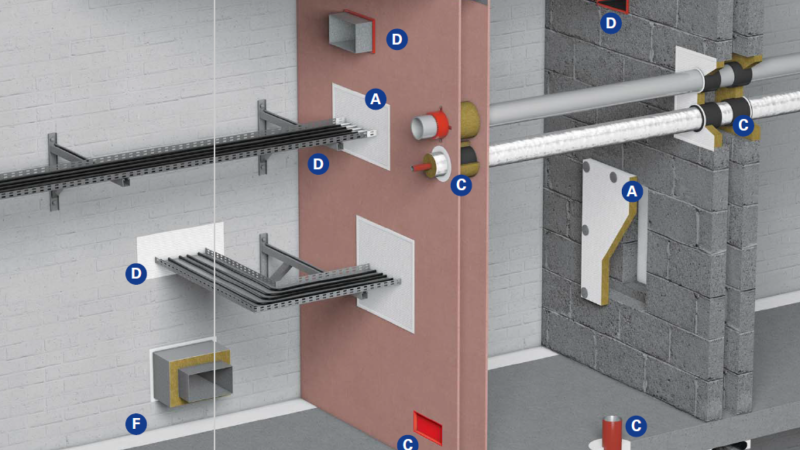
One of the most renowned challenges in construction concerns fire-safing interfaces between rooms or floors, with openings for technical services installations to pass through. Depending on the context, engineers can use specific fire-blocking solutions such as 2-hour fire-rated walls, which are designed to resist fire for that rated amount of time. The performance of the system is entirely dependent upon its assembly exactly as prescribed.

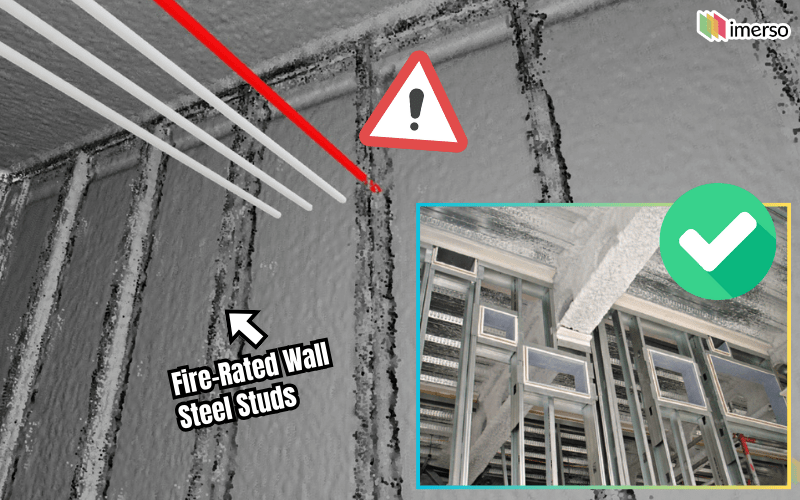
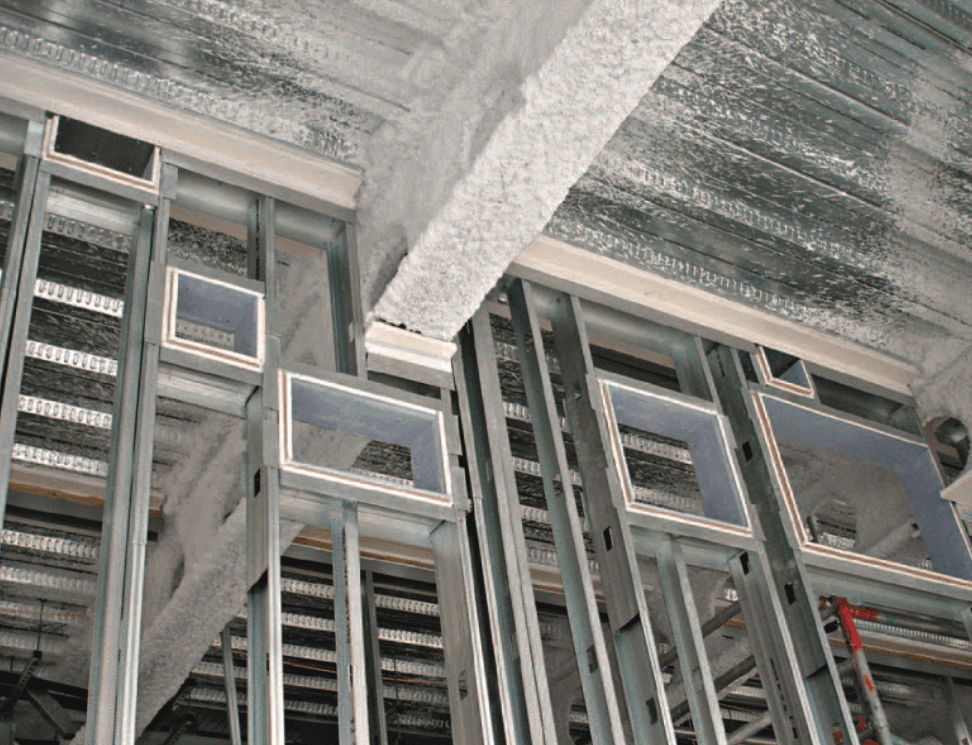
Metal stud framings must be placed at precise distances from each other and without modification, to preserve the intended fire rating. However, often only the vertical metal frame studs are installed, leaving the framing of openings for later.
Subsequent teams then struggle to install planned technical equipment across the walls, often leading them to cut the metal studs to make space and thereby compromising the fire rating of the wall.
The perspective of Design & Engineering
From the designers’ side, the onsite teams are responsible for installing the metal framing properly in accordance with the specifications while observing the layout in the BIM models for technical services.
Installing the fire-rated wall studs requires preparing encasing boxes framing the openings where technical installations of a certain size should go through the wall, complying with the specifications for a proper fire seal.
The perspective of onsite teams
From the onsite teams’ perspective, such a process requires a coordinated planning approach to ensure the layout for technical MEP/HVAC services is agreed upon before partition walls are erected.
It is ideal to have the openings prepared prior to the installation of technical services. However, doing this requires the service layouts to be accurately overlaid on the partition drawings in advance. This is rarely done. Design teams are often still optimising layouts during the construction phase, and even small changes to the layout of the services will affect the placement of the metal wall studs.
The problem typically happens when fire partition walls are closed from both sides, and you can no longer see inside.
Let’s say the MEP installer arrives later with a drill to work on the installation: it can happen that the wall studs are damaged and thereby compromise the fire integrity of the wall.
Anders Kaas, NHN Project Leader
Imerso enabled the construction management team at Nyt Hospital Nordsjælland to boost their site supervision ability 15-fold. This was achieved by enabling the team to take over 3D Scanning activities at the jobsite entirely by themselves as a daily routine – a task historically regarded as too time-consuming and requiring expert surveyor resources or costly third-party services.
This enabled Project Manager Anders Kaas and his team to prevent hundreds of costly issues within months, vastly surpassing their expectations for the technology. Read about the first 16 months' results here.
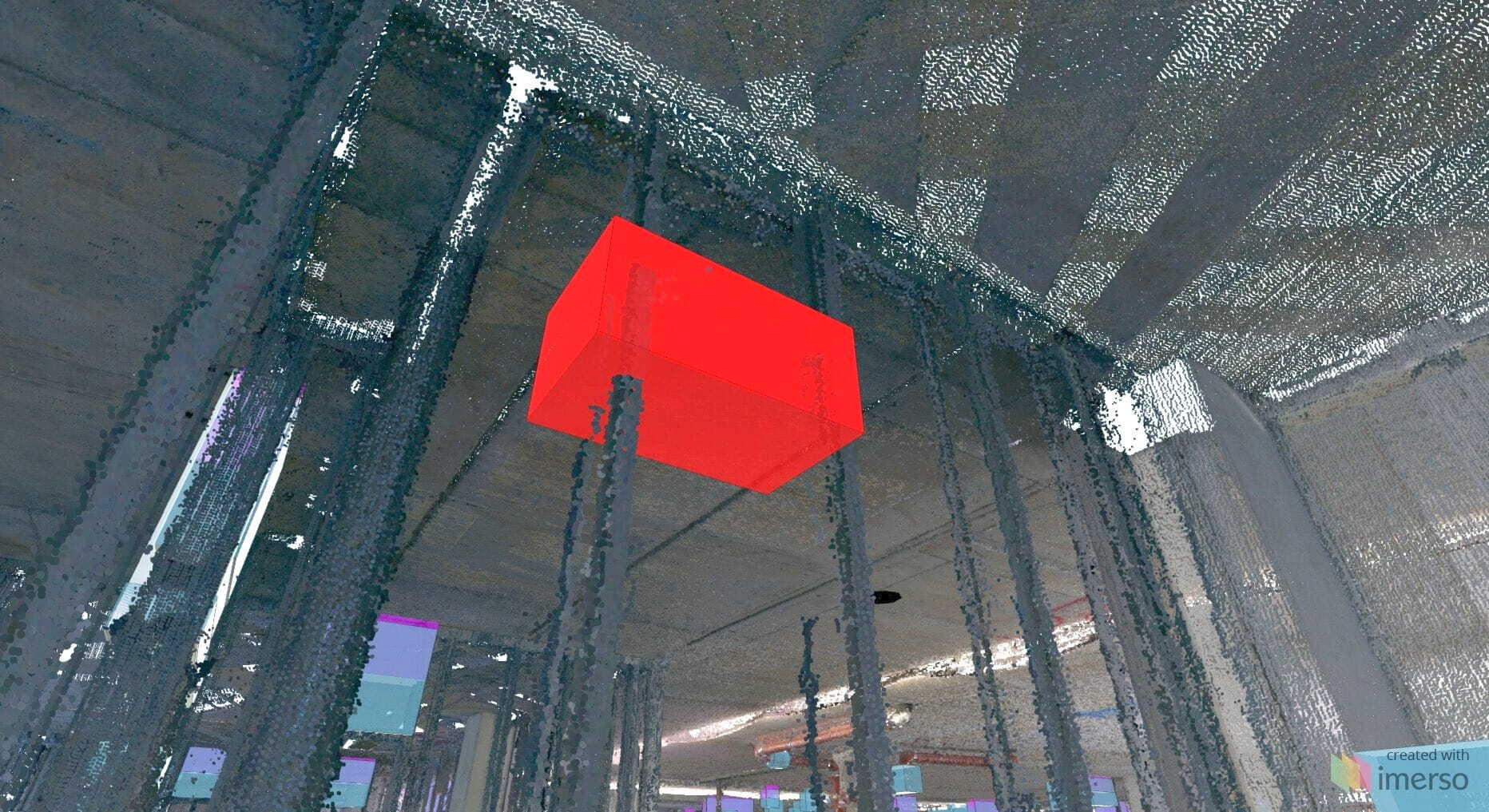
Anders’s team can easily monitor the installation of fire-rated wall studs on-site with millimetre precision, by recording the exact placement of metal stud framing in fire partition walls and have Imerso compare it to the current BIM plans.
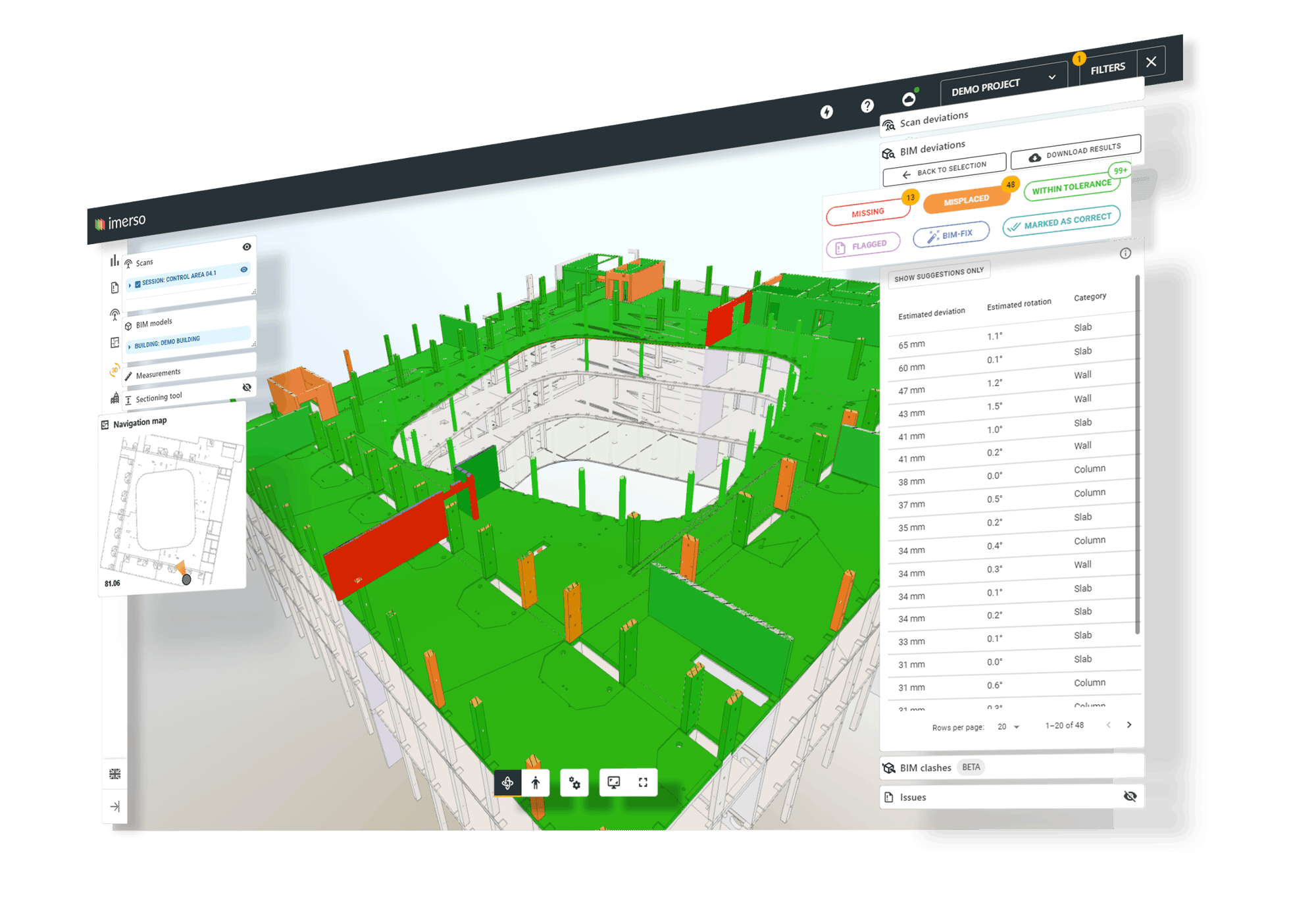
Imerso continuously analyses the As-built environment against the project’s BIM models, immediately reporting on work status and catching problematic deviations early.
Anders Kaas, NHN Project Leader
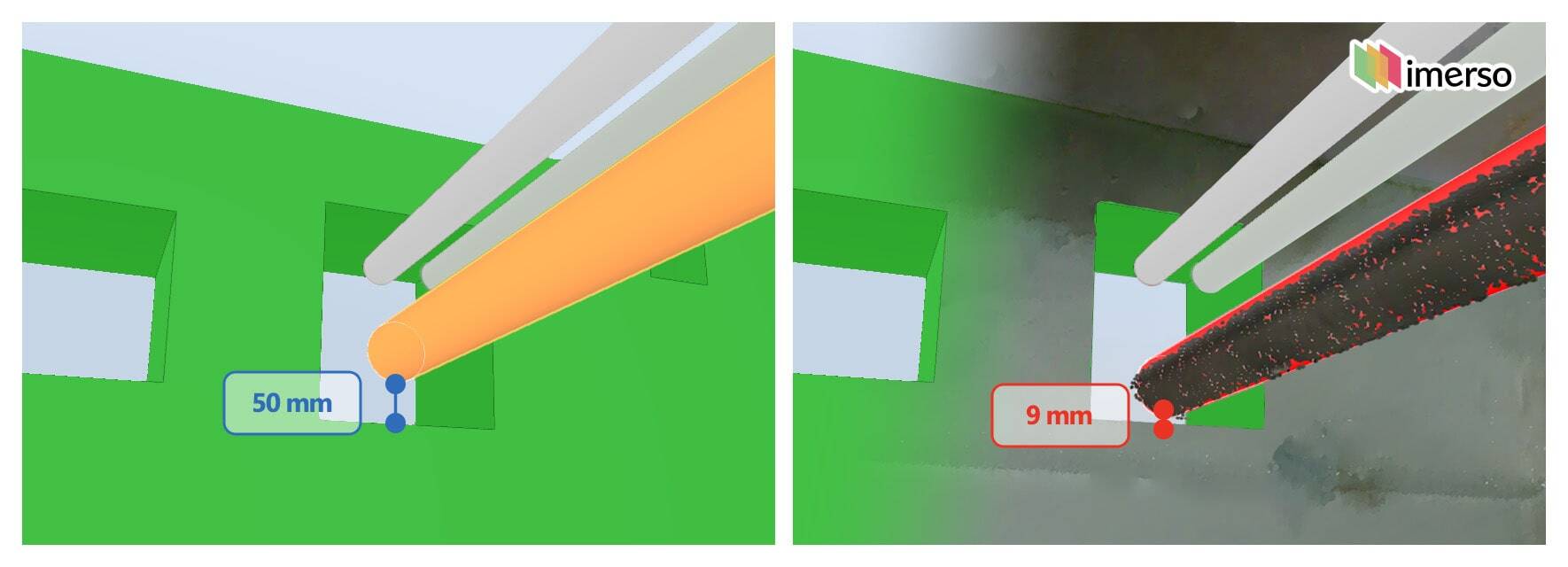
Another typical fire-stopping challenge in construction projects lies in the installation of technical equipment through wall openings in the concrete superstructure. To preserve fire-stopping capabilities, such equipment must be installed at specific distances from the structure and between each other, to allow appropriate fire-rated insulation.
The popular BIM coordination software Solibri, an industry-leading tool and partner of Imerso, launched new rulesets for validating fire-safety compliance automatically in the BIM models.
Nonetheless, the problem happens when the onsite installations deviate from the planned design and remain undocumented, since traditional manual and visual controls using photos, 360° panorama images, and manual checklists are ineffective at flagging such changes.
By analysing the onsite installation status against the BIM plans, Imerso helped the Nyt Hospital Nordsjælland team to prevent such hidden deviations from being overlooked, by detecting them instantly without human subjectivity.

The construction of each floor at the Nyt Hospital Nordsjælland project features hundreds of thousands of metal framings in fire-rated walls, making traditional construction control approaches reliant on manual checks, photos or panorama images too subjective and ineffective. This leaves dangerous blind spots in any construction project.
Using Imerso, the team can now prevent problems before they occur by detecting any deviations early and promptly sharing detailed information with the affected teams. Nonetheless, Anders explains that the strategy can only succeed given proper internal adoption and cross-partner collaboration:
"Imerso enables us to surface numerous cases likely to pose a serious threat to the project. This is a much better approach than the traditional way of monitoring work quality, but we are not hoping to present this as the perfect solution so everyone can relax.
Such risks can never be removed entirely, and no tech product will help if companies resist adapting and try new ways of working.
What we need most is to have an active organisation that takes full advantage of this new source of data and puts the right incentives to prioritise work quality in both 3D model coordination and physical installation.
Having helped put multiple cases on the radar with only a few hours of onsite scanning work per week, the team estimates that Imerso already helped prevent a significant amount in avoided rework costs in fire-rated wall cases alone. But Anders underlines that:
"While avoiding rework costs and delays is great, the construction savings in these cases are a drop in the ocean compared to the big elephant risk: that the hospital cannot open operations entirely because of compliance issues that such cases could bring.
That would be an enormous problem both in financial and societal terms.
Imerso’s impact on reducing project risk is invaluable."
Imerso boosted our site monitoring scope by 15x using only 7% of the resources of previous approaches.
It's impact on reducing project risk is invaluable.
Anders Kaas, NHN Project Leader
We'll walk you through a live analysis on a real project — and show what Imerso can do.
©2026 Imerso AS. All rights reserved. Privacy Policy